What Happens If Your Load Falls From a Vehicle? Legal Consequences Explained
Zakia AshrafMost drivers give their load a cursory look before pulling away and consider the job done. That's fine until something shifts, works loose, or drops onto the carriageway, at which point what felt like a minor admin task becomes a serious legal problem.
UK law on unsecured loads is clear, the penalties are significant, and the consequences of an incident can go well beyond a fixed penalty notice. Here's what you need to know.
What the Law Actually Says
The primary legislation is the Road Traffic Act 1988, which places a legal duty on drivers to ensure that any load carried on their vehicle is secure and does not pose a danger to other road users.
The specific regulation is Rule 98 of the Highway Code, reinforced by the Construction and Use Regulations 1986, which states that a vehicle must not be used on a road if the load is not secured so as to prevent any danger to any person. This applies whether you're carrying a mattress tied down with old rope, tools loose in a van, timber stacked on a roof rack, or a kayak with inadequate strapping.
The law doesn't distinguish between a load that falls and causes an incident and one that falls without consequence. The offence is carrying an unsecured load, not just the outcome of doing so.
The Penalties
Fixed penalty: Police can issue a fixed penalty notice of £100 and three penalty points for carrying a dangerous load. This is the minimum outcome for a straightforward stop.
Court prosecution: If the matter goes to court, which it can at the officer's discretion regardless of whether an incident occurred, the maximum fine is £2,500 for a car driver. For a goods vehicle, that rises to £5,000. Points on your licence follow.
Dangerous driving: If an unsecured load causes or contributes to an accident, the charge can escalate to dangerous driving or even causing death by dangerous driving, depending on the severity of the outcome. Causing death by dangerous driving carries a maximum sentence of 14 years in prison.
Civil liability: Separate from criminal prosecution, if your load damages another vehicle or injures another person, you face civil liability. Your insurer will want to know the circumstances. A load that was demonstrably unsecured is difficult to defend in a civil claim, and some insurers will void cover or refuse to pay out entirely if the load wasn't properly secured.
Who Is Responsible?
The driver of the vehicle is the primary responsible party. If you're driving a van for work and a load that wasn't properly secured by a colleague comes off on the motorway, you as the driver are legally responsible for ensuring it was safe before you set off.
For commercial operators, there's an additional layer. The operator of a goods vehicle can also be prosecuted if inadequate load securing is found to be a systemic issue, poor training, inadequate equipment, or time pressure that leads to corners being cut.
If you lend your vehicle to someone who then carries an unsecured load, the borrower takes on the driver's legal responsibilities. But if you knowingly allow an unsafe load to be carried in your vehicle, you can be implicated too.
What Counts as a Secure Load?
The law doesn't prescribe exactly which straps, ropes, or nets must be used, but it does require that the securing method is adequate for the load. Guidance from the Department for Transport sets out best practice for commercial operators, and the same principles apply to private vehicles.
In practice, a load is considered adequately secured if:
- It cannot move, shift, or fall under normal driving conditions including braking and cornering
- The securing method is appropriate for the weight and shape of the load
- The load does not overhang the vehicle in a way that creates a hazard
- Any overhang is marked if it extends beyond legal limits
A mattress held on with one bungee cord is not adequately secured. Neither is timber resting on a roof rack without strapping, or bags piled in a van with no load restraint whatsoever.
For cargo straps specifically, British Standard AU258:1995 sets the benchmark for elasticated cargo straps sold in the UK, covering strength, elasticity, and hardware reliability. Using straps that meet this standard, applied correctly, puts you in a demonstrably stronger position if your load securing is ever questioned.
The Most Common Scenarios
Roof rack loads: Timber, ladders, kayaks, bikes, and furniture are the most common culprits. The failure mode is almost always the same, inadequate strapping, not enough of it, or straps that worked loose over the course of the journey. Two proper straps and bow and stern lines (for long loads) are the minimum.
Van loads: Tools, equipment, and materials in an unracked van can become projectiles under heavy braking. A load that shifts forward in a collision is a danger to the driver as much as to other road users. Racking, load nets, and lashing points all exist for this reason.
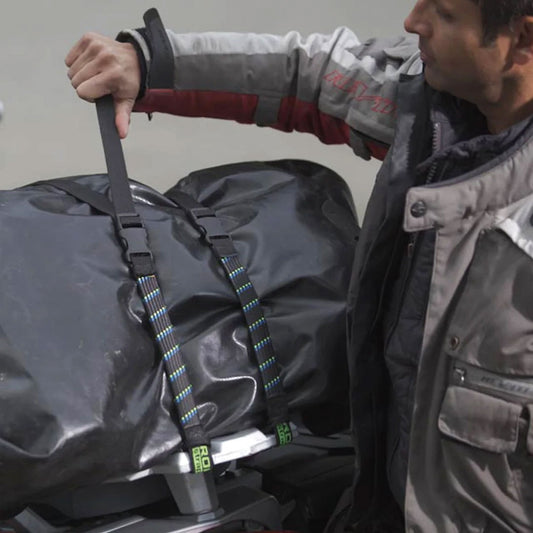
Motorcycle and bicycle loads: Tail packs, dry bags, and camping gear that aren't properly strapped can work loose over a long journey. The consequences of a load falling from a motorcycle are particularly severe, the rider is vulnerable in a way a car driver isn't.
Trailers: A trailer load is subject to the same rules as the towing vehicle's load. An unsecured load on a trailer is the towing driver's legal responsibility.
The Simple Version
If your load falls from your vehicle and someone is hurt, you are looking at a criminal prosecution, a civil claim, and the very real possibility of a custodial sentence if the outcome is serious enough. If your load falls and no one is hurt, you still face a fine, points, and a potential court appearance.
The fix is straightforward: use the right straps for the load, use enough of them, and check them before you move. A set of flat elastic cargo straps that meet British Standard AU258:1995, applied correctly with two anchor points, takes about two minutes to fit and removes most of the legal risk entirely.