Summer Camping by Motorcycle: Gear, Packing, and Strap Tips
Zakia AshrafThere's a particular kind of freedom that comes from pulling away on a loaded bike with a few days ahead of you and nowhere you have to be. No schedule, no boot full of gear, just what's on the bike and what's in your head.
Getting there takes some planning. Motorcycle camping is a different discipline to car camping, weight matters, balance matters, and what you strap on has to stay on regardless of what the road throws at it. Here's how to get it right.
What Gear to Actually Bring
The instinct when packing for a first motorcycle camping trip is to bring everything and sort it out later. The bike sorts it out for you. Space and weight are finite, and both affect how the bike handles.
Shelter: A one-man backpacking tent is the standard choice, sub-2kg, packs down small, and handles British summer weather (which means rain, regardless of the forecast). Avoid anything marketed as a "festival tent." They're heavy, bulky, and not designed to pack down to a useful size.
Sleeping: A three-season sleeping bag and a compact inflatable mat. Down bags pack smaller than synthetic for the same warmth rating, but lose insulation when wet, a compression dry bag is worth the extra gram. A mat is non-negotiable; sleeping on bare ground without one is cold and uncomfortable regardless of the bag.
Clothing: Three days of riding gear, two days of off-bike kit. Roll everything, it's more compact than folding and easier to pack into cylindrical bags. One waterproof layer that fits over your riding kit without removing your armour. Waterproof socks if you're heading north of the border.
Cooking: A small gas canister stove, one pot, a spork. That covers coffee in the morning and a hot meal at the end of the day. Lightweight titanium cookware if you're counting grams; cheap aluminium if you're not.
Tools and emergency kit: Puncture repair, tyre levers, a small multi-tool, a basic first aid kit, and your phone charger. These live in an accessible pocket or tank bag, not buried at the bottom of a tail pack.
If it doesn't fit and it isn't safety-critical, it doesn't come.
How to Pack a Motorcycle for Camping
Where you put the weight is as important as how much you're carrying.
Keep heavy items low and central. Your sleeping bag, tent, and cooking gear should sit as close to the bike's centre of gravity as possible, low on the bike and between the axles rather than hanging off the back. A high rear load raises the centre of gravity and makes the bike feel top-heavy, particularly at low speeds and on loose surfaces.
Panniers before tail packs. If your bike has hard panniers or a frame for soft ones, use them before piling on a tail pack. Panniers keep weight low and symmetrical. A tail pack is useful for lighter, bulkier items, sleeping mat, tent body, but shouldn't carry the heaviest kit.
Balance side to side. Weigh your panniers if you can. An uneven load pulls the bike on bends and makes filtering uncomfortable. Tools, fuel, and cooking gear distribute well across both sides.
Tank bags for essentials. Phone, snacks, waterproofs, wallet, anything you need access to without stopping. A tank bag keeps these accessible without requiring you to dig through a tail pack on the side of the road.
Soft bags beat hard cases for camping. Hard cases are excellent for commuting and touring with hotel stops, but for camping, soft luggage compresses with the load and makes strapping a sleeping mat or tent to the outside a lot easier.
How to Strap Your Load Down Properly
Packing the gear is half the job. The other half is making sure it's still there when you arrive.
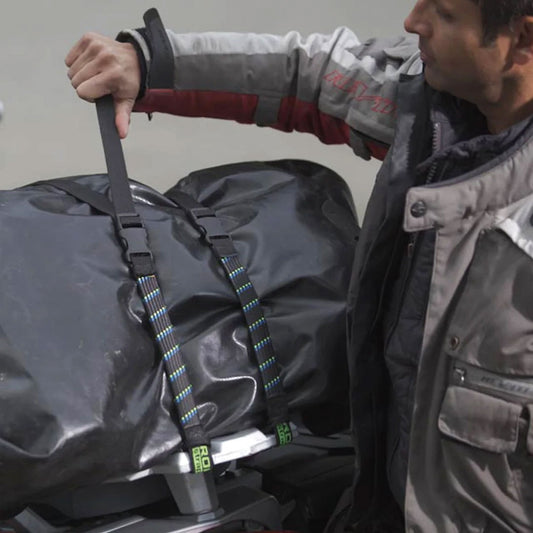
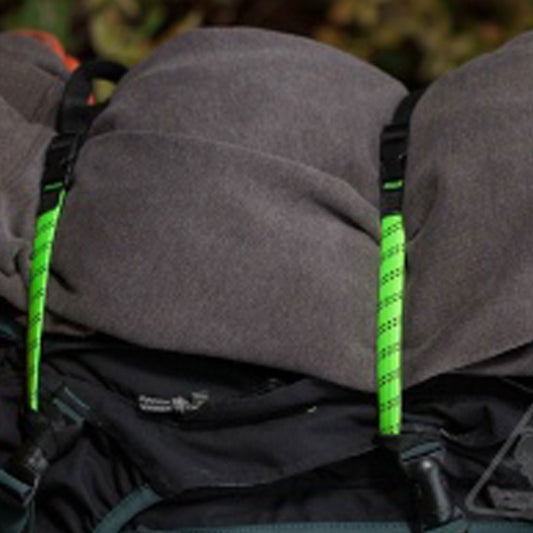
Use flat elastic straps, not bungee cords. A bungee cord contacts your load on a single line, concentrates tension on that point, and hooks that work free under vibration snap back at speed. On a motorcycle, that means a cord into your wheel or across your hand. Flat elastic cargo straps distribute tension evenly, maintain consistent hold over bumps and through corners, and the hookless versions have no sharp edges to damage paintwork or fairings.
Two straps minimum. One strap across the middle of a tail pack or dry bag does almost nothing to stop it pitching forward under braking. Route one strap towards the front of the load and one towards the rear, this controls movement in both directions and the load won't shift regardless of what the road does.
Route straps through anchor points, not around them. Loop the strap through a rack loop or grab handle point rather than around the outside of the rack rail. This makes the anchor point do the work and stops the strap sliding under load.
Secure compression straps and loose ends before you ride. Any strap tail, buckle, or loose end that can reach a wheel will eventually find it. Tuck everything away before you pull out.
The ROKStraps Motorcycle / ATV Stretch Strap is built specifically for this. It extends to 1,500mm, holds up to 45kg, uses a hookless loop-through system, and is British Standard AU258:1995 compliant. The reflective stitching is useful when you're loading up at dawn or breaking camp in fading light. For lighter loads, a jacket, a dry bag, a helmet secured to the bike at a stop, the Commuter Stretch Strap is more compact and quicker to deploy.
A Few Things That Catch People Out
Fuel range changes when you're loaded. A full tail pack and panniers add aerodynamic drag and weight. Your fuel consumption will be higher than you're used to. On unfamiliar roads, don't push past two-thirds of your normal range between fill-ups.
Suspension sag is real. A loaded bike sits lower at the rear, which affects steering geometry. If your bike has adjustable rear preload, increase it for touring weight. If not, be aware that the bike will feel heavier in direction changes until you've adjusted your riding to match.
Check your load after the first 20 miles. Straps settle, bags compress, and loads shift in the first stretch of a journey. Pull over, check tension, re-adjust if needed. After that first check, a properly strapped load shouldn't need attention until you stop for fuel.
Wild camping rules differ across the UK. In Scotland, the Land Reform Act gives a general right to wild camp on most unenclosed land. In England and Wales, there's no such right, you need landowner permission or a designated campsite. Know where you're allowed to pitch before you head into the hills.
Motorcycle camping in summer is one of the best things you can do on two wheels. The kit list is shorter than you think, the packing method matters more than most people realise, and the difference between a load that stays put for 300 miles and one that needs constant attention usually comes down to the straps.
Get the weight low, keep it balanced, use flat elastic straps with a proper anchor point, and check it once at the first stop. After that, just ride.