How to Take a Motorcycle on a Ferry: What to Prepare and How to Secure the Bike
Zakia AshrafIf you've never taken a motorcycle on a ferry before, the process can feel more complicated than it is. It isn't. Most ferry operators handle bikes regularly, the process is well-established, and with a bit of preparation your bike rolls off the other end in exactly the condition it rolled on.
Here's what to do before you go, what to expect when you get there, and how the bike gets secured for the crossing.
Book as a Motorcycle, Not a Car
This sounds obvious but catches people out. When booking, select motorcycle as your vehicle type, don't book a car ticket and plan to bring the bike. Motorcycle fares are priced separately, usually significantly cheaper than a car, and come with a dedicated loading process.
Most operators will ask for the make, model, and approximate dimensions of the bike. Some ask for engine size. If you're travelling with a passenger, book them as a foot passenger or check whether they're included in the motorcycle fare, it varies by operator.
On busy summer routes, Cairnryan to Belfast, Portsmouth to Bilbao, Dover to Calais, book well in advance. Motorcycle spaces are finite and popular routes fill up fast in July and August.
What to Do Before You Arrive at the Port
Fuel down before boarding. Most operators require the fuel tank to be no more than a quarter full for fire safety reasons. Some are stricter than others but as a rule, arrive with a low tank. Fill up on the other side.
Remove or secure loose items. Anything that can be lifted off the bike easily will need to be taken with you into the passenger areas. That includes tankbags, loose luggage, and anything not hard-strapped to the bike. Most operators don't allow passengers to return to the vehicle deck during a crossing, so anything you want access to, passport, medication, phone charger, needs to come with you when you leave the bike.
Check tyre pressures and make sure the bike is in good mechanical order. This isn't a ferry requirement but a practical one. A breakdown on the vehicle deck or, worse, on a foreign road with limited recovery options is avoidable with a basic check before you leave home.
Turn off the alarm if your bike has one. A bike alarm that triggers in the hold during a crossing is a serious nuisance and will not endear you to the crew. Disable it before boarding.
Arriving at the Port
Follow the signs for motorcycles, most ports have a dedicated motorcycle waiting area separate from cars and HGVs. Check in at the booth as normal, hand over your booking reference, and you'll be directed to the bike lane.
You'll likely wait with other bikes until a crew member calls you forward to board. This is worth paying attention to, the loading sequence matters on a vehicle deck and they'll direct you to a specific spot. Follow their instructions exactly. Don't choose your own spot.
How the Bike Gets Secured on Board
This is the part most first-timers are uncertain about. The short version: the ferry crew do it, using their own straps, and they do it dozens of times a day. You don't need to provide straps for the crossing itself.
What happens in practice is that once the bike is in position, crew members run lashing straps from the bike's frame, typically from the lower frame rails or subframe, not from handlebars or bodywork, to lashing rings on the deck. The bike is usually strapped on both sides and may be chocked at the front wheel as well.
What you can do to help:
Tell the crew if there are any attachment points on your bike that shouldn't be used, cracked subframe, bodywork that's loose, aftermarket parts that aren't structural. They'll work around it.
If you have a centre stand, deploy it before they strap the bike. It gives the bike a more stable base and is better for the suspension on a long crossing than resting on the side stand with straps pulling against it.
On rougher crossings, particularly Bay of Biscay routes and some North Sea services, the crew may use additional lashing. If you're worried about the crossing conditions, mention it. Experienced ferry crew have seen everything and will tell you honestly whether extra securing is warranted.
What not to do:
Don't add your own straps to the bike after the crew have finished. The lashing pattern is deliberate and adding tension in a different direction can work against it. If you're not happy with how the bike looks, talk to the crew, don't just add more straps on top.
Protecting the Bike During the Crossing
The crew's straps go on the frame, but that doesn't mean your bike's paintwork and bodywork are automatically protected.
Fit bar end caps if you don't have them. On a crowded vehicle deck, a neighbour's mirror or a crew member's kit bag will find your bar ends eventually. Caps are cheap and prevent marking.
Consider a breathable bike cover. Not all operators allow full covers on the vehicle deck, check before you travel, but a half-cover over the seat and tank protects against the salt air and spray that gets into vehicle decks on rougher crossings. Avoid waterproof covers that trap moisture against the paintwork.
Park next to a wall if you get the choice. You'll only have a neighbour on one side rather than two. Less chance of contact from other vehicles shifting during the crossing.
Loading Your Gear for the Trip
Everything that comes off the bike at boarding needs to go back on at the other end, efficiently, in the right order, before the car deck clears and the crew are chasing you out.
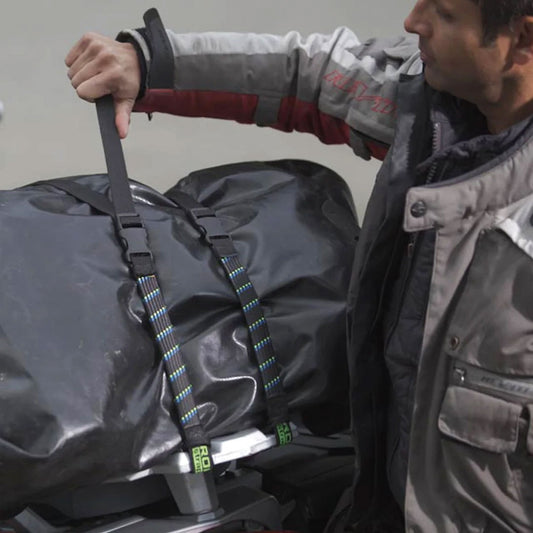
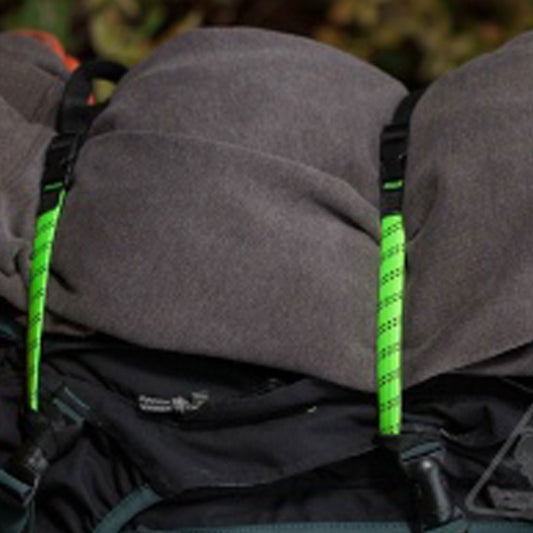
Pack so that the items you need first at the destination are accessible last when loading. Strap the main luggage load, dry bags, tail packs, roll bags, before you get to the port so the process of reloading at the other end is fast. Two flat elastic straps through the rack loops, tensioned properly, and the whole thing is back on in under two minutes.
The ROKStraps Motorcycle / ATV Stretch Strap is particularly useful here, the quick-release buckle means you can get the main load on and off fast at both ends without fumbling with hooks or re-threading webbing from scratch each time. For smaller items: a jacket, a helmet bag, a drybag strapped on top, the Commuter Stretch Strap deploys and releases in seconds.
The Routes Worth Knowing
UK to Ireland: Cairnryan–Belfast (Stena/P&O, around 2 hours), Holyhead–Dublin (Stena/Irish Ferries, around 3.5 hours). Both are straightforward short crossings with regular sailings. Good starting points for the Wild Atlantic Way and the Ring of Kerry.
UK to France/Europe: Dover–Calais is the fastest crossing (around 90 minutes) and the standard gateway to Europe. Portsmouth–Caen, Portsmouth–Cherbourg, and Poole–Cherbourg are longer but put you further west and are better starting points for Brittany, the Pyrenees, or heading south.
UK to Spain: Portsmouth–Bilbao and Portsmouth–Santander (Brittany Ferries) are overnight crossings of around 24–32 hours. Longer but they drop you deep into northern Spain and save 1,000 miles of French motorway. Very popular with tourers heading to the Pyrenees or Portugal.
Scotland to Northern Isles: CalMac runs regular services to Orkney and Shetland. Shorter crossings from Scrabster to Stromness (90 minutes) and Aberdeen to Lerwick (12 hours overnight). Both are excellent for riders who want genuinely remote roads.
Taking a motorcycle on a ferry is one of the more straightforward parts of a touring trip once you've done it once. Book as a motorcycle, arrive with a low tank, take everything off the bike that isn't strapped down, let the crew do the securing, and have your load ready to go back on quickly at the other end.