How to Secure Luggage on a Bicycle Without Scratching the Frame
Zakia AshrafMost cyclists learn the hard way. Cheap bungee hooks, a bit of road vibration, and by the time you reach your destination there's a fresh gouge in the paintwork. The method you use to secure your luggage matters as much as the luggage itself.
Why Bungee Cords Damage Bicycle Frames
A metal hook contacts your frame on a single point. Under road vibration, that point works back and forth, and even a plastic-coated hook will eventually cut through lacquer. The round cord does the same where it crosses surfaces, concentrating tension on a narrow line.
Then there's the recoil problem. A bungee under tension that slips free snaps back at speed. On a bicycle, that means a cord across your spokes, derailleur, or leg.
The fix isn't better bungees. It's a different system.
Use a Flat Strap, Not a Round Cord
A flat elastic strap distributes tension across its full width rather than a single contact line. The load stays in position instead of rolling and slipping, and there are no pressure marks on your frame or your kit.
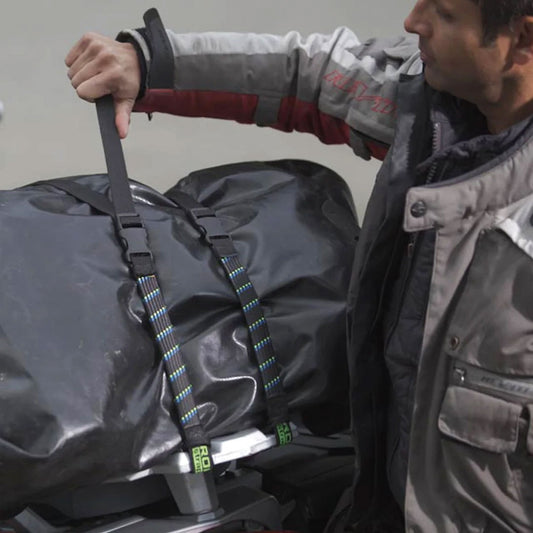
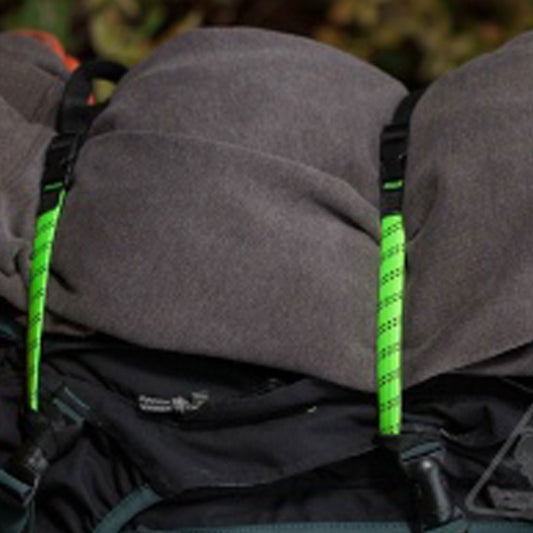
Flat elastic cargo straps like ROKStraps use a natural rubber core for consistent, shock-absorbing tension over rough ground, with a woven polyester outer that won't mark surfaces. The hookless versions loop through your rack or anchor point, zero metal-to-metal contact, zero scratch risk.
How to Strap a Load to a Rear Rack
Route straps under the rack rail, not around it. This makes the rail the anchor point and stops the strap sliding along it mid-ride.
Use two straps for anything over a couple of kilograms. One strap across the middle does almost nothing to stop a load pitching forward under braking. One strap towards the front, one towards the rear — that controls the load in both directions.
Centre the load before strapping. An uneven load is harder to secure and affects handling at low speeds. Heavier items sit better placed low and forward on the rack.
Tension firmly, not excessively. The elastic maintains tension naturally. Once it's set, you won't need to re-check it every stop.
Tuck away excess webbing. On a bicycle, a loose tail can work its way into the rear wheel.
No Rack? Protect Every Contact Point
For seatpost-mounted bags, add protection between any strap and the post, particularly on carbon, where even low-level strap compression can cause long-term damage. A strip of bar tape or neoprene does the job.
For frame bags, pad every point where the bag contacts bare tubing: top tube, down tube, seat tube. Check after the first few rides that nothing has shifted through.
Which ROKStrap for Cyclists?
Commuter Stretch Strap : the everyday choice. Compact, rated to 18kg, quick-release buckle for fast on/off. Reflective stitching built in for low-light commuting.
Pack Stretch Strap : lighter and more compact, suited to touring loads: bedrolls, sleeping bags, smaller bags. Packs down small, adds minimal weight.
Both use the same hookless loop-through system and natural rubber core. British Standard AU258:1995 compliant.
Scratched frames come down to the wrong methods, metal hooks, round cord, tension on a single contact point. Switch to a flat hookless strap, route it under the rail, use two straps for any real load. That's most of the problem solved before you leave the drive.