How to Secure a Roof Rack Load: A Practical Guide
Zakia AshrafA poorly secured roof rack load is one of the most common, and most avoidable, hazards on UK roads. Under the Road Traffic Act 1988, an unsecured load that falls from your vehicle isn't just dangerous, it's a criminal offence. The good news is that getting it right takes less than five minutes if you know what you're doing.
Here's everything you need to know.
Check your weight limits first
Before anything goes on the roof, check two figures: your vehicle's roof load rating (in the owner's manual or on the B-pillar door sticker) and your roof rack's own load rating. The lower of the two is your actual limit. Most passenger cars sit between 50kg and 100kg including the rack itself.
Even within the limit, roof loads raise your vehicle's centre of gravity and increase stopping distances. Keep heavier items as low and centred as possible, and reduce motorway speeds accordingly.
Choose the right strap
This is where most people go wrong.
Bungee cords are the worst option for roof rack use. The round profile contacts your load on a single line, allowing cargo to pivot and shift. The hooks slip free under repeated movement, and the recoil when they do is genuinely dangerous. UK road safety guidance advises against using bungee cords for primary cargo securing.
Ratchet straps hold firm but can't absorb vibration. Over a long journey they can work loose, or over-tighten and damage softer cargo like luggage and bags. The exposed metal hooks also risk marking your crossbars and paintwork.
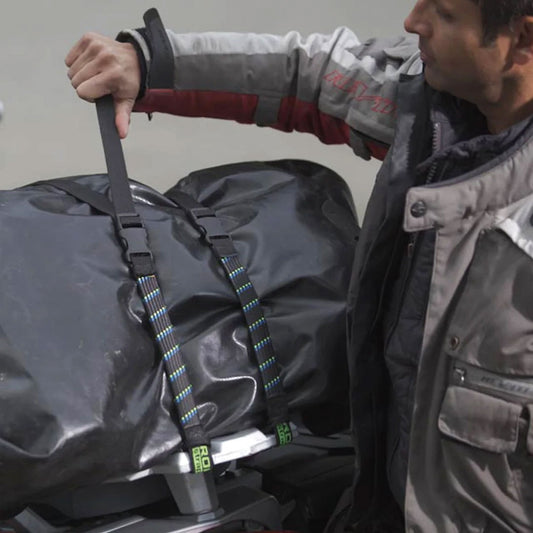
Flat elastic cargo straps are the better option for most roof rack loads. The flat profile distributes tension evenly across the surface of your cargo, preventing rolling and pressure marks. The elastic section absorbs road vibration and maintains consistent tension throughout the journey without mechanical over-tightening. The ROKStraps Adjustable Strap extends up to 4.5m with plastic-coated hooks and a ROK™ quick-release buckle rated stronger than the strap itself, and it complies with British Standard AU258:1995.
Distribute the weight properly
- Heaviest items centred and low - height amplifies the handling effect of weight
- Balance side to side - an uneven load pulls the vehicle, especially on bends
- Heavier items forward - a front-heavy load is more aerodynamically stable than a rear-heavy one
- No overhang beyond the vehicle's width - this is both a safety hazard and illegal
Route your straps correctly
Use at least two straps: one towards the front of the load, one towards the rear. A single strap across the middle does almost nothing to prevent the load pitching forward under braking.
Loop under the crossbars rather than around the rack rail. This makes the crossbar the anchor point and prevents the strap sliding along the rail during transit.
Cross your straps diagonally for soft or bulky loads, one front-left to rear-right, one front-right to rear-left. This creates a far more stable hold than two parallel straps.
Secure all excess webbing. Loose strap tails flapping at motorway speed wear quickly and can work their way into doors or wheels. The ROKStraps buckle lets you set the exact length you need, no excess to manage.
Before you set off: quick checklist
- Load is within vehicle and rack weight limits
- Heaviest items centred, balanced side to side
- No overhang beyond vehicle width
- Minimum two straps, routed under crossbars
- Excess webbing secured
- Load doesn't obscure number plate or rear lights
- Strap tension checked, firm but not crushing
Check tension again at every fuel stop on long journeys. Temperature changes and road vibration can both work buckles loose over time.