Family Road Trip Packing Guide: How to Fit Everything In Without Losing Your Mind
Zakia AshrafThe average family road trip involves approximately three times more luggage than any car was ever designed to carry. Two adults, two kids, a week's worth of clothes, a pushchair, a cool box, three bags of "just in case" and a roof box that seemed like a good idea at the time.
It doesn't have to be chaos. With the right loading order, the right kit for the roof, and a clear system for what goes where, you can leave the drive without a tetris session and arrive without everything having shifted into a single compressed mass.
Start With What You Actually Need
Before the packing starts, edit the list. Family road trips suffer from the same problem as all group travel, everyone packs for every possible scenario and nobody makes the hard calls.
Clothes: Enough for the trip plus one spare day. Not one spare outfit per person per day. Kids are the main culprit here, they genuinely only need one change per day and one extra. Anything more is dead weight.
Shoes: Two pairs per person maximum. One for activity, one for everything else. Shoes are the single most space-inefficient item in any bag and the most over-packed.
Toys and entertainment: One bag per child, packed by them, carried by them. If it doesn't fit in their bag, it doesn't come. This works better than it sounds, kids are surprisingly selective when the decision is theirs.
Baby and toddler kit: This is the area where there's genuinely no cutting corners. Nappies, wipes, formula, medication, spare clothing, pack what you need and don't economise on the things that matter. The space savings come elsewhere.
The Loading Order That Actually Works
How you load the car matters as much as what you put in it. Random loading means the thing you need first is at the bottom, the heavy items are at the top, and by the end of the second day everything is in the wrong place.
Step 1: Heaviest items lowest and furthest forward in the boot. Suitcases, pushchair, cool box, these go in first, flat on the boot floor, as far forward as the boot allows. Heavy items high in the load raise the car's centre of gravity and affect handling on long motorway runs.
Step 2: Soft bags fill the gaps. A rigid suitcase leaves dead space above and beside it. Soft holdalls and duffel bags compress and conform, pack them in around the hard items to use the full volume of the boot.
Step 3: Frequency of access drives position. The cool box that you'll open at every service station doesn't go at the back under everything else. Snack bags, kids' entertainment, and the first-night bag all need to be reachable without unpacking the entire boot.
Step 4: Roof for bulk, not weight. A roof box or roof rack is ideal for the sleeping bags, the inflatable mattresses, the windbreaks, the items that are large but light. Never use the roof for heavy items, it raises the centre of gravity, increases fuel consumption, and on an emergency stop, a heavy roof load makes the car handle differently to how you'd expect.
Roof Box vs Roof Rack: Which to Use
Roof box: Best for soft items that need weather protection, sleeping bags, pillows, clothing, lightweight camping gear. Completely enclosed, so contents arrive dry regardless of the weather. The trade-off is cost, noise at motorway speeds, and the faff of fitting and removing it if you only use it a few times a year.
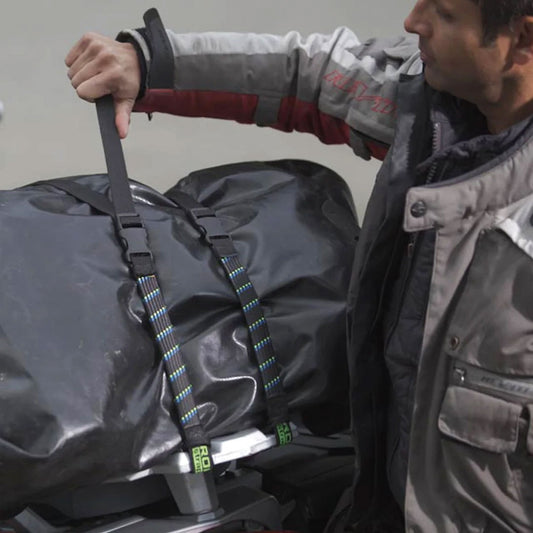
Roof rack with straps: Better for bulky items that won't fit in a box, camping chairs, a folded travel cot, a bike, a kayak. More flexible than a box, cheaper, and faster to load for experienced users. The load needs to be properly strapped: at least two flat elastic straps through the crossbars rather than around them, and nothing that can catch wind and lift.
The key mistake with roof loads: a single strap across the middle of a load. It looks secure. It isn't. One strap controls vertical movement but nothing stops the load pitching forward under braking or sliding sideways in a crosswind. Two straps, one towards the front of the load, one towards the rear, is the minimum for anything on a roof rack.
ROKStraps Adjustable Straps extend to 4.5m, which covers virtually any family roof rack load. The plastic-coated hooks won't mark your crossbars and the quick-release buckle means the load is on and off in under two minutes at each end. British Standard AU258:1995 compliant, which matters when you're doing 70mph with the kids in the back.
Keeping the Car Organised on the Road
A well-packed car at departure is a disaster area by day two without a system.
Designate zones. Boot is luggage, nothing comes out until you stop for the night. Back seat footwells are daily kit: snacks, drinks, entertainment, nappies. Door pockets are rubbish and small items only.
One bag per day. Instead of packing by category (all clothes together, all toiletries together), pack by day, a separate bag for each day of the trip with everything needed for that 24 hours. It sounds like more work upfront but it eliminates the boot unpack at every stop.
A roof rack check at every fuel stop. This takes 30 seconds and is non-negotiable. Strap tension, load position, nothing working loose. On a long motorway run, flat elastic straps hold their tension well, but the first fuel stop after loading is when any slack in the system shows itself.
Snack management. A dedicated snack bag that lives in the front passenger footwell, restocked from the main supplies at service stations. Keeps the back seat from becoming a crisp-packet archaeology site by the second day.
The Boot Bag Trick
One soft bag designated as the "top layer" bag, the last thing in, the first thing out. It holds everything you need at the overnight stop without unpacking the boot: pyjamas, toiletries, phone chargers, tomorrow's clothes. At the end of each day's driving, you pull out one bag and that's it.
It takes ten minutes to pack properly before you leave home and saves twenty minutes of unpacking at every overnight stop.
A Few Things That Catch Families Out
The return trip is always heavier. Gifts, seaside tat, food bought at the destination, the windbreak you didn't plan to buy. Leave a quarter of your roof space empty on the way out. You'll need it.
Check your roof load limit. Your car has a maximum roof load rating, typically between 50kg and 100kg including the rack itself. It's in the owner's manual or on the B-pillar door sticker. Exceeding it is illegal and affects handling. The lower of the car's rating and the rack's rating is your actual limit.
A full cool box is heavy. A large cool box loaded with drinks and food for a family can weigh 20kg or more. That goes in the boot on the floor, not on the back seat and absolutely not on the roof.
Height changes with a roof box. Multi-storey car parks, drive-throughs, and low farm gates that were fine without the box are suddenly a problem with one fitted. Know your loaded height before you go.
Family road trip packing is a logistics exercise, not a last-minute scramble. Edit the list before you start, load heavy items low and early, put bulk on the roof with two proper straps rather than one, and have a system for keeping the car organised on the road.
The trip itself is the easy part. Getting out of the drive without leaving anything behind, that's the hard bit.