Cargo Straps for Kayaks, Bikes, and Outdoor Gear: A Guide for Adventurers
Zakia AshrafOutdoor kit is expensive, awkward to carry, and unforgiving if it shifts on the move. A kayak that works loose at 60mph on the A303 is a different problem to a tent that slips off a rack halfway up a Welsh pass, but the cause is usually the same. Wrong straps, wrong method, or both.
This guide covers the main adventure use cases: roof-rack kayaks, loaded bicycles, and general outdoor kit, and the strapping approach that works reliably for all of them.
Strapping a Kayak to a Roof Rack
A kayak is one of the most unforgiving loads you can put on a roof rack. It's long, it's light relative to its size, and it catches wind like a sail at motorway speeds. Get the strapping wrong and you'll know about it before you've left the dual carriageway.
Use cam buckle or flat elastic straps: not ratchets, not bungees. Ratchet straps can over-tighten and deform a kayak hull, particularly on plastic boats. Bungee cords don't provide enough consistent hold for a load this size and shape. Flat elastic straps with a firm buckle give you controlled, consistent tension that absorbs road vibration without working loose or crushing the hull.
Bow and stern lines are not optional. Roof rack straps hold the kayak down onto the bars. Bow and stern lines, running from the kayak's grab handles to your front and rear tow points, stop the boat pitching forward or back. Both are needed. UK road law requires that any load extending beyond the vehicle must be properly secured; a kayak without bow and stern lines doesn't meet that standard.
Route straps over the hull, not under the bars. Pass the strap over the kayak and under the roof rack crossbar on each side. This sandwiches the kayak between strap and bar, which is a far more stable arrangement than looping around the outside of the rack.
Use cradles or foam blocks if you don't have J-hooks. Flat contact with the hull distributes the load and prevents hull distortion over a long journey. A bare crossbar concentrates load on two narrow points, fine for short trips, not ideal for hours on the motorway.
Before you pull away, check that the kayak doesn't rock side to side and that the bow and stern lines are taut. At your first stop, re-check strap tension, roof loads settle in the first 20 minutes of a journey.
Loading a Bicycle for Adventure Riding
Bikepacking and touring loads present a different challenge: everything needs to be secure over rough ground, accessible on the move, and light enough that it doesn't compromise how the bike handles.
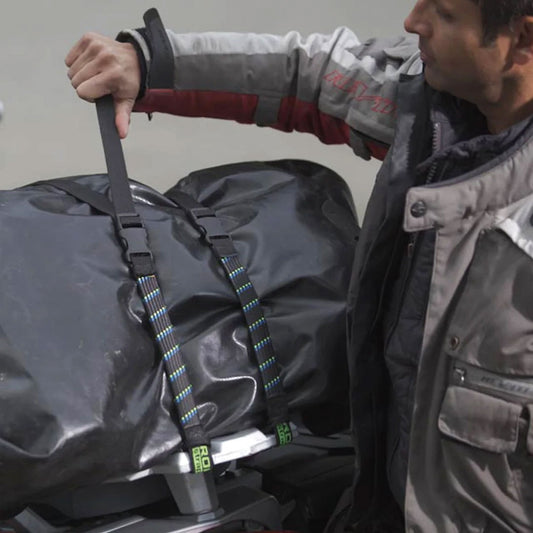
Rear rack loads: Use two flat straps, one forward, one rear, routed under the rack rail rather than around it. This stops the strap sliding along the rail and controls the load in both directions. A single strap across the middle is not enough for anything that weighs more than a kilogram or two.
Frame and seatpost mounting: Any strap that contacts bare frame tubing needs a protective layer between them. Bar tape, neoprene, or a strip of old inner tube will do it. On carbon frames and seatposts, this isn't optional, direct strap contact over time causes surface damage even at low tension.
Handlebar bags and dry bags: The bag system handles the mounting, but if you're adding supplementary strapping, use hookless flat straps only. Nothing that crosses the stem or bars should have metal contact points, and nothing should be able to work free into the front wheel.
The ROKStraps Commuter Stretch Strap is well suited to bicycle touring, rated to 18kg, compact enough to carry as a spare, and with reflective stitching for early starts and late finishes. The Pack Stretch Strap is the lighter, more minimal option for ultralight setups.
Securing Outdoor Kit: Camping Gear, Drybags, and Equipment
General outdoor kit covers a wide range: tent poles strapped to a pack, a drybag bungeed to a roof box, tools lashed into a van for a climbing trip. The principles are the same regardless of the specific load.
Match strap length to the job. A short strap on a large load means improvised routing that puts tension in the wrong places. The ROKStraps Adjustable Strap extends from 0.5m to 4.5m — useful for awkward shapes and oversize kit where a fixed-length strap won't reach cleanly.
Keep straps off sharp edges. Tent poles, paddle shafts, and similar equipment have edges that will eventually cut through a strap under repeated vibration. Route straps across flat surfaces where possible, or pad the contact point.
Secure compression straps on packs before strapping to a vehicle. Loose straps on a rucksack or drybag will work themselves free over a long journey. Everything should be tied off before the outer strap goes on.
Check reflectivity on early starts. A lot of adventure travel involves pre-dawn loading. ROKStraps' reflective stitching is a practical safety feature here, it makes load checks easier in low light and improves visibility of the load itself if you're working on the roadside.
Quick-Reference: Which ROKStrap for Which Job
| Use case | Recommended strap | Why |
|---|---|---|
| Kayak roof rack | Adjustable Strap (up to 4.5m) | Length for full hull coverage, consistent tension |
| Bicycle touring | Commuter Stretch Strap | Rated to 18kg, hookless, compact |
| Ultralight bikepacking | Pack Stretch Strap | Minimal weight, quick release |
| Camping kit / drybags | All Purpose Stretch Strap | Versatile mid-size, scratch-free hooks |
| Van / trailer loads | Heavy Duty Strap | Maximum hold for heavier equipment |
All ROKStraps are British Standard AU258:1995 compliant, made with a 100% natural rubber core and UV-resistant polyester outer. Built to handle UK conditions year-round.
The right strap for adventure use is flat, elastic, and either hookless or fitted with coated hooks that won't mark surfaces. Two straps beat one. Bow and stern lines on a kayak are non-negotiable. And for anything with a long journey ahead of it, a tension check at the first stop takes thirty seconds and saves a lot of grief.